Tuesday, May 2, 2023

"Put on 'The Odd Couple'......"


Part of public grammar school, undeniably, is a certain amount of indoctrination.  Just in case you don’t have parents at home to drill these foundations into you, teachers very pronouncedly reference certain lifestyle structures that are certainly good ones, like having dinner with one’s family at night, proper diet and bedtime habits, etc.  But there’s one lifestyle reference that came up more than often, which in our home, for some reasons, we never did. We never all sat around the TV in the evening and watched the news together, and discussed it in the process.

It's not as though there was ever any lack of educational lecture and analysis in our home, of the international political and economic scene of the time, which couldn’t be afforded enough public classroom focus due to lessons on King Tut.  And at home, I was equipped personally with one of the most articulate and knowledgeable teachers possible.  No license or degree, but boy, could she teach. My mother, by middle age, had no matriculated college background to speak of, but after a life of various secretarial jobs, in between reading every printed word in the bookstores, devouring English Literature, and absorbing every political journal of the 1950s and 60s as a statistician knows numbers, her eloquent and passionate grasp of Israel’s plight could not for one moment be doubted.  I was her sole pupil.

Seemed like we’d be prime candidates for a team screening of some Evening News at 7PM, or maybe the local stuff at 6.  If I could actively tune in to watch the network evening news, with a proper knowledge of how to do so, then perhaps I’d feel a little more justified in watching television altogether.  It wouldn’t be the guilty pleasure so many of those TV Guide columnists at the time would seek to defend. But our home and it’s matriarch did not aspire to such banality.  It was a conscious decision.

My mother bore no respect for the commercial television news presentations of our time. She looked upon those ad-filled, star-studded blocks as the ultimate bastardization of what once was, in the time of Edward R. Murrow, the Great White Hope.

At some point, when those recurring classroom drops about parent-child news viewing and “family discussion” finally got to me, I asked my mom……”Why don’t we actually watch the news…?”

Somehow, in our home anyway, the thought of making a point to sit in front of the TV and watch a nightly newscast of any sort was akin to dining on salt and pepper as a main course.  News was not a focal point of tune-in viewing.  It was just “on” all the time, ubiquitously.  If your TV was on non-stop, as our Magnavox black-&-white portable was in our little 1978 abode, TV news just sort of wallpapered the room in one way or another, with mid-day news briefs, updates and the like.  Long before things like CNN. From the time I was three, raised at first in my uncle’s home, I already knew who all the big flagship-station news anchors were:  Jim Jensen, Walter Cronkite, Roger Grimsby, John Chancellor.  Invariably, a portion of the evening newscasts were always purring out of the TV at or after dinnertime. No one was necessarily riveted to it, but the car and soda jingles were fun to sing along to before Animal World came on.

Those iconic impresarios, the dapper “stars” of the Evening News, were the undeniable décor of our lives.  But how much of these showcases truly served up any kind of genuine recommended nutritional value..?  And that was my erudite mother’s pseudo-intellectual exception taken with the nightly news on the dial.  My inquest was met with a dissertation that expressed favor of print news, such as The New York Times, over such eye candy as ABC World News Tonight.

Where’s the inquisitive study on these pocket-sized stories we’re pelted with..? How do we objectively identify figures associated with a story without employing some perfunctory sense of pre-emptive bias..?  Is there a generalized slant relative to anything other than a need to shut up and get the commercials on..?

It was in the 1980s when my high school journalism class was visited by a guest speaker, a local television newscast producer.  He was asked by a pupil what forces the decision on stories chosen, citing the story just the night before of a young girl shot to death in Harlem, which two competing newscasts featured in ten second reads.  This fellow’s presentation did not.  The producer went on to explain the applied science of “disposable stories”, relied upon for the purpose of filling that spare ten broadcast seconds.  A good many of those ten-second tragedy reports are unsurprisingly dropped at broadcast time, in order to clear the headline story: The President arrived in the city today, to eat barbecued ribs at an event, and discuss the missile budget.

And the sports..! Don’t forget the sports. For all my mother cared, the obsession with sports reporting in a male-dominated sports obsessed culture (it certainly was then..) did not belong in a respectable newscast.  Was she wrong..?

In the 1960s, pressure was put upon CBS News Director Fred Friendly to have a sponsored Heywood Hale Broun sports commentary segment installed at the end of each night’s Walter Cronkite CBS Evening News.  Broun was uniquely prolific as a sports analyst.  But, as Friendly held, as it was, there was just barely enough time on any night to read and present every relevant piece of national news  For reasons not entirely unrelated in principle, Friendly departed the network a couple of years later.

My mother did not rely upon television newscasts, or “news shows” in order to stay informed.  If some story was breaking, TV is where we saw and heard about it.  But then, my mom would follow it in The New York Times, as well as the in-depth documentary and discussion offerings of public television.  To her, a commercial television newscast was an improper travesty in too many ways.  And it was for this fundamental reason, that the evening news time periods that have long defined post-war video-culture Americana served as alarms In our home, reminding us to switch the dial promptly, to a channel serving up something of genuine viewing value, an independent station presenting movies or favorite old TV show re-runs.  No ritual is more recollective to my childhood than the nightly call from the kitchen upon the peal of that “Coming up next on Eyewitness News..” tease after The ABC Friday Night Movie, to “…put on The Odd Couple..!”, over on Channel 11, perhaps New York's highest rated TV presentation in that time slot back then.

And it was in those pre-adolescent, indulgent times, that along with the jumbo bowl of Heavenly Hash ice cream on Friday and Saturday nights, the extra cookies I knew I’d soon need to give up if I wanted to lose that critical hemisphere waistline once and for all, it was that aversion to those formally dressed, formally produced, formally spoken, mature and often demure presentations that left me in some state of irresponsible, indulgent guilt:  Am I some ignorant news slacker..?

Taking the focus off the self-destructive self for just one moment, let’s ask some better questions.  Why for the last sixty years have so many off-network series in re-sale, many less than initially successful in prime time, made such lucrative hay for independent television stations, who have long used them on a nightly “strip” basis to directly counterprogram the news broadcasts on the network-affiliated stations..? Is there in fact a significant, and in many cases, highly educated audience craving alternative to the news we all “should” be watching nightly ..?

Meanwhile, just how deeply integral are those local and network television news structures..?  It was the late, great Fred Friendly and his industry contemporaries that came out of the influence of radio news in the War Era, when a news presentation, report or commentary, focused on the story, the matter, the purpose.  A story’s headline coverage had nothing to do with whether or not the sunset in the next few minutes will destroy the story because it won’t hit the reporter’s coiffed hair on camera just so.  There was no “star system”, no six-part lifestyle reports, no meaty opportunities for team network reporters politically vying to get that mostly disposable report of theirs from the Honduras, the reporter in his slick beige military duds, hair blowing like a Calvin Klein ad, the piece placed just seconds away from a break beginning with….a Calvin Klein ad..!

It's conclusively possible that a half hour of The Odd Couple, The Honeymooners, or even The Benny Hill Show would offer just as much insight into the globe’s collective challenges as something akin to an ego-covered pageant that slaps one’s intelligence in the face.

And nearly fifty years after the cultivation of the "news slacker", we've got something much more contemporary and chic, en route to it's Golden Anniversary:  The "news junkie".  The exponential harvest of electronic news-presentation platforms over nearly the last fifty years has reformulated that substance long known as "news" into literally a highly, and in some ways toxic, addictive substance.  Its properties take on nearly an entirely separative function in the content's embrace of the neurocortex.  The viewer is transformed almost into William Hurt's portrayal of the experimental figure in Altered States.  Ironically, that very paranormal tale was penned by Paddy Chayefsky, the visionary who brought us that bizarre scarefest in 1976 called Network.  

It's possible that Network itself has not yet seen it's fiction become straight reality, if for no other reason, too many people still remember the movie.  But in the forty-plus years since it's premiere, we've come close enough to the goal posts.  

I won't soon forget that afternoon in 1980 at the bus stop with my mom.  I was all of eleven, living in one of those cable-deprived homes, relegated to simply reading the listings of all those curious pay-TV treats in the following week's TV Guide, which I scored us at the newsstand.  The centerfold was a handsome, glossy, 24-hour breakdown of program listings for the all-new Cable News Network.  Much of it by half-hour flaunted "News Headlines".  By 3AM of any day, I had to wonder.......how much developing news is there going to be from one half-hour to the next.   I'd heard of little ten-minute newscasts from the announcer before a TV station signed off after the late movie, but wouldn't these people quickly run out of presentable news...? What's the plan...??  I talked about this with my fairly unimpressed mom.

Her prophetic, and moderately sardonic observation:  "I guess they'll have to invent some news of their own..."  

Long before Daniel Boorstin coined the term "pseudo-event" of course, the practice itself could date back to biblical times.  As wise people have told me, the world existed before we got here.  The immense harvesting of "news networks" and "news services" cannot subist solely on that one elusive, natural source.  Man has to step in and manufacture some.  It's just part of the business that's good for business that's good for America.

If it’s saints one is looking for in broadcast journalism, the on-camera pontiffs themselves, the former Cronkites, the Chancellors, Reasoners, Smiths, and their integral disciples don’t really hold water. They have daily jobs. They work for people who work for people, who will claim, in all conceivable honesty to work for The People.  The viewer.  They who voluntarily view.  It’s an endless chase of the proverbial tail.

And the question of integrity in commercial broadcast news gathering and presentation is anything but new.  Again, contributors to The Bible in their time just might have been able to tell you a few industry stories. And none of this is to in any way negate or dismiss the masterwork of those who have brought us the most distinguished coverages in the last seventy years of the assassinations, shuttle explosions, storm disasters, and each and every broadcast employee who put their adrenal impulses aside to keep us informed on 9-11.

It is, sadly and ironically, such disaster that ends up redeeming an aerobic biosphere that feeds off its own money-generating capacity in order to survive and exist.

Ron Powers probably thought he was blowing a significant lid off the industry when his literary creation, a study titled The Newscasters hit the stationary store pulp racks in the late 1970s. By then of course, the video epidemic was common knowledge. Powers' book was basically an excoriation of the Age Of Ron Burgundy upon us.  How did local Station Managers and News Directors deal with the critics’ charge upon this reality…?  Astute businessmen that they were, many held, quite valiantly, that they were providing their core audience with just what they wanted to see at the end of the day. Viewers knew what they wanted too.  If you can make the veggies yummy enough, people won’t pass them up for the pudding. From a culinary standpoint, news was good when it was delicious.  In a world of expanding local news afternoons, days and evenings, no one can pass up a smorgasboard.

Ever wonder if those once-guilty treats can now be appreciated decades later, in a semi-historical context..?  In recent years, all those journalistically substandard half-hours benevolently uploaded on line by like spirits, absorbed with history and nostalgia of times past, have allowed this disciple, pining for the simplicity of youth eras prior, to take an invaluable ride.  A thirty-minute excursion, commercials, continuity and all can resurrect one’s fascination and desire to go back to that innocent, news-switching youth just briefly. A different time. A different place.  The one we know best. Can an old relic find precious antique value..?  I’ll let you know when I’m done with it for the first time.

Noah F.


a

Thursday, April 13, 2023

A Guided Life....


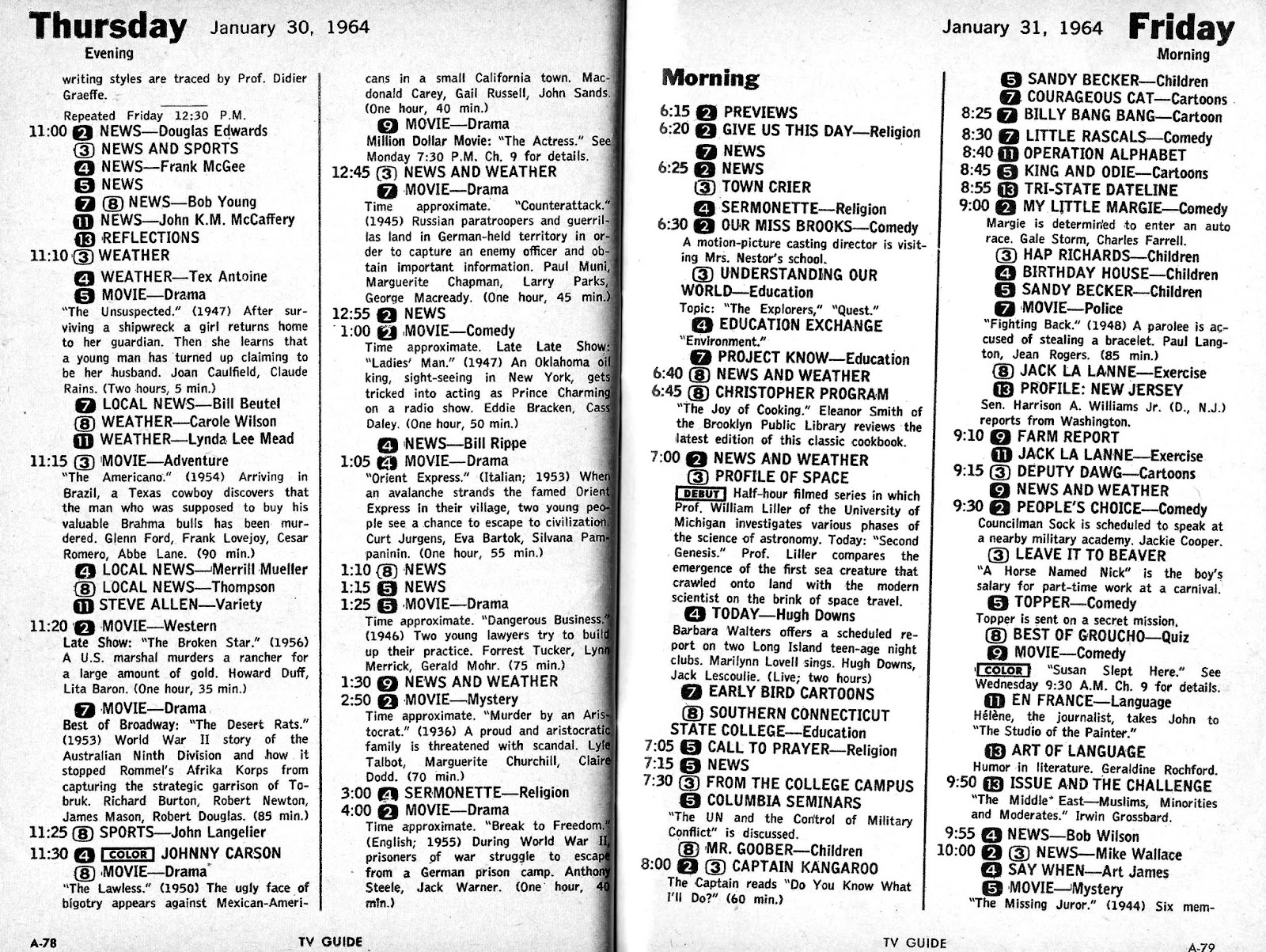
In what at one time prior I would have anticipated greater fanfare, a small on-line blurb I recently scrolled past reminded us that a cornerstone fixture of my formidable youth, and no less than a significant piece of American cultural furniture long gone, has struck the esteemed age of seventy.

There were no specially-crafted collector's editions in the magazine section of CVS or any other stores published to commemorate the seventieth anniversary of the national launch of TV Guide.  Sad as it might appear, the defining reality is that the very medium in the form that the publication once nursed is also, for all intent and purpose, no longer.

Yes, there is today something called television.  You can plug it in, and turn it on, and even without any kind of subscription service attached, you might get a requisite batch of channels watchable.  But the mediascape today is so narrowcast and scattered that finding your way through it on any short notice is the equivalent of what a curious crystal set owner like young Bill Paley in the early 1900's, "DX"-ing his way across the dial may have done.   

The last print material digest-form issue of TV Guide would arrive in 2005.  And by that time traditional TV was all over but for the magazine's farewell.  While it would continue as a standard-sized tabloid newsstand item, it's purpose, and for a good many, its identity, was no longer.

What made this long top-selling publication the consumer magnet that it was..?

It served a distinct purpose, for one.  An East-Coast newspaper publisher in 1946 recognized what was going to happen with this thing called television, that wasn't going away.  He figured that in short time there would be enough activity on that dial to warrant a constant offering of convenient and accurate daily listings, better than a daily paper could provide.  So to supplement the new medium fan-zine called TeleVision Guide, which he'd just acquired, a news-print insert of the week's local listings would be added.  If it took off, bureaus could open in other cities to provide the same locality to the nationally-released fan-zine.   It worked..! Go figure..!  The inner text of those daily listings would become visual icon to a nation over the decades.

Much as the medium's style, form and content would see radical revision over the years of the Guide's run, so did the magazine's format see it's cosmetic revisions.  The type-setting of the listings would become smaller, more concise and uniform in description, sleeker by the decade.    


My family's home, the one in which I first began to grow up, was a TV Guide home.  My aunt bought it every week from the checkout rack at Waldbaums.  If I didn't see it on top of her Ethan Allen coffee table all the time, I might have doubted I was home.  It was in the early 1970s that my eyes, aged five, six, seven, began to recognize the glowing box in the living room, and the offerings I liked.  The Guide was somehow an inseparable supplement.  Even if I wasn't yet reading it.

In time, though, I was.  I was one of those egg-headed, nerd-cliche early readers.  Parents love and celebrate those kinds of kids.  Other kids usually sneer and threaten them.  When I wasn't being sneered at and threatened, or buried in homework, I was perusing the Guide.   

While my relationship with TV Guide began largely with the quest for a command over the forecast of any important movies I longed to catch, the listings alone were an exotic voyage.  Not only did they include the full VHF assortment (all six channels!) and various UHF's you couldn't see (I certainly couldn't with those old UHF twister dials), but also present were inverse-colored channel designations for those in the nearest broadcast state, in our case, Connecticut.  While reportedly, some in the far reaches of New York, New Jersey or Long Island could in fact pick these stations up on their TV, no such offering existed in the deep of Queens.  This meant that if A Hard Day's Night starring The Beatles was on Channel 8 at four in the afternoon, all you could do was lament not being able to finally see it.  But the presence of all that throughout the weekly Guide made it all the more an experience.  Much like some claim to equate reading picturesque tales of abroad with actual travel, to me TV Guide did the very same.   At age nine I would wonder just what it was like to have what was my usual I Love Lucy re-run at 7pm in my life at 4pm, the way Channel 3 viewers did in Harford.  While to many that may seem insignificant, for those whose lives held TV and it's schedule as their compass, this was life's identifiable shape.

It was in the early 1970s that the magazine would probably reach it's peak of sophisticated distinction.  That was the decade that saw a tidal wave of the urbane population expressing outward snobbery toward the proclaimed "Idiot Box".  In reality, it was little more than what was later the rock-loving crowd loudly disrespecting Disco.  To be accurate, the ubiquitious joke on the whole thing resided in the fact that most of these TV-attacking snobs somehow always knew what was happening on The Young And The Restless, or who was on the Cavett show the other night.  If they were questioned about this mysterious knowledge, there was always a ready excuse, such as, "I was at my sister's house....she's always got the damn thing on..."

TV Guide however, knew of this denial in the dichotomy.  To capture what was a more intelligent population, the magazine devoted most of its article and editorial space to the debate and critique of the medium, by some pretty austere writers like Richard Doan, Edith Efron, and weekly review sections by Cleveland Amory and Judith Crist.  No one was going to show more unbiased critique of The Box than TV Guide.  And what could be more honest than doing so in a booklet full of TV listings..?  In the same way that Norman Lear's All In The Family found its wild popularity in the audience's ability to see itself in a full-length mirror, TV Guide was America's way of justifying a guilty pleasure that would help us realize wasn't quite so guilty.  Could a magazine serving up original writings by such occasional contributors as Arnold Toynbee or Isaac Asimov, and original cover artwork by Al Hirschfeld possibly be in advocacy of anything bad..?

It was during that historic Vietnam War-Watergate period, a time when my folks paid a little more attention to offerings like The New York Times Magazine and the Saturday Review, that TV Guide was probably something of a literary contender.  In more recent years, as my charcoal temples have lightened, I've come to absorb more and more the subject articles amidst my cultivated library of 1970s TV Guide editions.  It wasn't just for movie hunting. 

The deep dive into those editions and their articulate scriptures allow this former child to live vicariously in a time fifty years prior, perhaps among the adults, Back To The Future-style.  In the 1970s, times weren't good.  Everyone was hit by inflation, crime and uitility strikes in a way still unknown to many today.  My folks were raised by those who survived The Great Depression.  And to leaf through a TV Guide replete with listings for ABA Basketball, Star Trek re-runs and Cannon at 9pm, just as my uncle watched it each week, I'm made aware of what kept our republic quite so grounded and unified in it's most precarious time:  Television.

Perhaps though,  the greatest gift one could glean from one or more vintage editions would have to be that of personal nostalgia.  If fond memories and TV were a common connection in your life, there's a good chance that the TV Guide from your particular city on that particular date remains one of your prized possesions.  I've one or more such Guides, and for those like myself, there is no more comforting, warmer blanket in an oft-tepid world.  If an unforgettably miserable night in your childhood is one for which you maintain that evening's TV Guide, you just might take comfort in perusing those listings now, with the greater awareness that a night is just a night, with a Tony Orlando & Dawn hour you looked at while worrying about something else.  Much like the sun, moon or weather each day, so there was television.   TV Guide reminded us of that.

I've nurtured my nostalgia through more than one publication, like editions of Archie Comics, MAD Magazine, and preserved vintage electronics store catalogs.  TV Guide however was like a homing device.  The very listings at 11pm for "News" on all local channels was kind of a visual equilibrium.  If I wasn't in bed asleep by that hour back then, I knew something was very wrong.

When the mediascape widened just enough with no point of return to anything minimal, the makers of the magazine keenly knew when to hang it up.  From age eleven I can recall the alienated beginnings of Pay-TV listings making their way prominently into the Guide.  Just one more inclusion I could only read about but not see.  Twenty-five years later, the so-called Box would be an anarchy of over several hundred channels, more that even Fred Silverman may have predicted decades back.  No weekly journal could conceivably document all of it.  The era of TV Guide was well over.

But what makes the second-hand bookstore such a draw in the world..? Surely one could find nearly any literature relevant or necessary over the web today.  The reason is that demand for the material, in a nutritionally dense virtual world.  To pick up that published work bearing a pub date of 1978 is, almost regardless of content, a voyage to another time, a parallel universe.  So it is and more with the preserved back issues of TV Guide.

My childhood fascination with the pop cultures that preceded me were aided and tour-guided certainly enough by my earliest discovery of the Guide's beginnings.  I must have been eleven years old when the world around me was absorbed with Star Wars.  School was all about King Tut and the New World Explorations.  I couldn't get into any of it.   I was busy reading and watching any documentaries out there on the Golden Age of Television, and it's earliest 1950s beginnings.   There was actually a lot of that stuff floating around back then, and I lapped up as much as I could.  And whatever the shows and books didn't present, there was the genuine article:  Rare editions of TV Guide.   To me, they were the Dead Sea Scrolls. None of my folks would ever come to understand of course why this eleven year old was buried in an old 1959 TV Guide he bought for six bucks at Mike's Comic Hut.  But I did.


To peruse that journal was to visit the very world David Halberstam would later write about in The Fifties.  It was an artifact of a time we would never see again.   Decades later, into the next century, the shape of the medium itself, and the population TV Guide long serviced would be an element of the society we'd never quite see again.  For a good many of us, the young curmudgeons unimpressed by the new personal technologies and trends, our compass remains on those previously printed grounds.   And we're not ashamed to admit it.

Much like anything else it ripped unapologetically, the creators of Seinfeld at some point took comic aim at TV Guide collectors.  What those creators chose not to acknowledge was that there were even, during the height of the show's wild fame, a good many contemporary people that did not know what Seinfeld was.  But if you were a Seinfeld enthusiast, you probably recall observing its Thursday night listing in TV Guide.  

It's those of us by whom our best memories are measured by the Guide's inner listings over the decades that are loyal friends to the Facebook pages administrated by those benevolant original-page scanners, those who provide that nostalgic comfort to like souls and the historically-inclined.  With similar types devoted to the uploading of obscure and valuable old TV broadcasts on line, it's not so impossible to suddenly match a found TV Guide excerpt with an actual hour of that stuff.  One just might be able, for a few moments, to live virtually, in a world once purely material.  

The Saturday Review, it ain't.

Amidst all the other published fact-filled journeys of our life's once-iconic structures, there is unquestionably more than ample space on the bookshelves and order sites for a studied history of TV Guide, it's founding, it's sales growth throughout late 1900s economy-decimated America, and it's slow and polite decline.  But in spite of my life's notable craving for such non-fiction literary adventures, I've somehow no appetite for that when it comes to the Guide.  Rather, I'm more than content to adopt my intimate recollections of those inner pages as my very own.  No need for advanced analysis or deeper observation.  To some extent, it's art.  And if you have to explain or define art, as Groucho Marx proclaimed in Horse Feathers, "....I'm finishing this ride with the duck".

I remember the first time I caught that film as a small boy, with my mom on a Sunday afternoon.  I still recall it fondly from time to time.  I just happen to own that TV Guide.

Noah F.


Monday, December 5, 2022

When Dying Was Hard...


An older gentleman, a kindly neighbor of mine whom I'll encounter frequently, confounds me.  He is a fellow taller and somewhat stouter than my humble frame.  He is endowed with a diaphragm that sends his voice blocks further than mine. He's also notable for a tendency for something I've long been incapable of.  He can laugh his ass off at length.

There are a good many who at worst may find such a trait just slightly annoying.  At some point in time, I might have myself.  But in fact I don't, really.  I've come to look upon this wise fellow with great awe. If anything, any annoyance on my part is generated by a genuine envy.  I see this man double over in giggles at the slightest, most foolish little joke, and I don't see a man well beyond my middle years.  I see the eleven-year old boy I was in this same province over forty years ago.

Not since my pre-adolescent years can I recall such a steady run of predictable non-stop laughter.  As a child, perhaps through to my late teens, I can well recall occasions of heavy laughter.  My home and family were the source of plenty of well-meant laughter and humor, when things weren't occasionally miserable.  You know, the usual domestic anthropological environment.  I was a pretty good childhood giggler.  My mother was known to crack up riotously, amidst her depressive cascades.   She held fast to the concept of laughter and humor not as some frivolous enjoyment, but as a desperate life force.  She knew it's value, and never took it for granted.

I was too small to understand such science, but I sure knew how to laugh when a laugh came my way.  And I needed it.  Daily life as a child was not a welcome environment.  I was much the quiet, scorned outcast, the Charlie Brown no one wanted in their circle.  I never really made the effort to relate to the interests of the other kids, since they weren't about to show me too much respect, anyway.  They were all absorbed with sports, Star Wars, and KISS.  I was way more content with old Simon & Garfunkel and Bob Dylan albums, Golden Age Of Television anthologies and the hand-creation of designed model Rock-Ola jukeboxes out of old cardboard boxes.  Not bad for a ten-year old.  It beat the isolation of a world I couldn't live within too well.

This didn't make the pending transition to middle school any easier.  Particularly in view of the self-generated letdown I'd faced.   I'd been taken on a tour the year prior to see where my classmates and I were headed.  I saw the workings of a very mature looking interior.  Individual old-style desks, wooden floors, something akin very much to a Rockwell portrait.  I'd envisioned a way more sophisticated proscenium, much like an episode of Happy Days.  I wanted an argyle sweater.  Never mind the fact that this was the vulgar late 1970s.  My own world was the one I chose to live in.

Trouble is, that biosphere didn't do too well within the world we had.  Shortly after my arrival into the seventh grade, I was introduced to something more closely resembling Scared Straight.  I didn't know if I'd make it in this place.  It was during this ominous time that I found myself in the frequent company of an odd classmate named Alan.  We may have bore some kind of physical resemblance, though I was certainly a visible Felix to his haphazard Oscar.  I sported an unmanageable head of Beatlemania hair, while his was a scurry rats' nest.   He marched around in what looked like more than one layer of slept-in polo shirts, and rather than a trendy knap sack, he carried his notebook and papers all scrumpled in a flimsy convenience-store plastic bag.  There was something oddly comical about him. The only thing that made it less odd and more comical was Alan's personality.  It was a public confirmation on his part that his appearance and persona was to be simply laughed at and not questioned.  For a boy of twelve, just a few months older than I, this kid had a bizarre sophistication in his grasp of humor.  Probably not unlike an entertainer such as Robin Williams at a young age, this kid had serious comedy chops. He'd adopted the character of TV's notorious Archie Bunker as his own, and in an almost Hal Holbrook-like fashion, brought the character to life on the spot, bursting not only into well-known phrases from All In The Family, but projecting his own thoughts and reactions into the character in classic theatrical improv fashion.  I found Alan stunning, in a way none of our peers did.  I also found him outrageously hilarious.

I'd grown up on All In The Family myself, and thrived on it's humor.  Now I was an exclusive audience to an odd kid who sought me out.  We'd first gotten to know one another through simply a series of odd encounters, as often happens in school.  In short time though, two friendless kids shared an unspoken alliance.

In short, the attraction to Alan was laughter.  The kid's brilliance cracked me the hell up no matter what day or time it was.   I could be heading into a fatal math test and double over in stitches from his exquisite Bunker-esque outbursts. He absorbed the character the way Dick Van Dyke was known to absorb Stan Laurel.  It was on any level fascinating. 

Each morning Alan would expect me over in our corner of the schoolyard.  I'd have it no other way.  Our meetings to start the day were critical.  For the first time in my life, weekday mornings were something to look forward to.  I didn't know if I'd ever have this kind of blessed existence ever again.  So I wasn't about to take it for granted now.  

Our shared iconoclasm amidst a mostly square student body bore no intimidation on me, certainly.  As Peg on a later episode of Married With Children explained it to Marcy with regard to sex, "When Peggy Bundy is getting it regularly, we go with the flow.."  That was generally me with this.  

And there was just one reason:  The hard laughter never stopped.  I never forced a laugh.  Not once.  I stifled too many.  There was indeed an entire school year during which I basked in the guiltiest pleasure of genuine, uncontrollable laughter nearly every minute.

Not surprisingly, it had to end.  One day, after an unwelcome encounter with some terrorist bullies, a frustrated Alan took to excoriating me for my lack of aggressive defense.  I could easily have accused him of the same, but his whole form of semi-theatrical dialectics prevented any kind of conversation.  It was then, eight months into our friendly association that I began to recognize a few troublesome things about Alan.

I'd already met his mother, who would come to retrieve him after school.  A fairly young woman, she appeared well older, and worn.  She bore a personality almost louder and theatrically more comical than her son's. But not quite as funny as slightly dubious.  I didn't know too much about mental health at age twelve, but I knew something wasn't quite right about these folks.

My instincts were not wrong.  Yet this boy remained functional enough to attend public school.  Until he wasn't quite up to it.  Turned out, he would transfer after that year to some sort of privatized school for challenged youngsters.  I was told little about it in depth, but it was clearly a behavioral issue.

The prior spring, Alan abruptly decided I was the ineffective enemy to his resolve to turn vigilante of sorts.  At his initiation, we parted ways at term's end.  After a mostly lonely summer, betrayed and frustrated, I was met in the fall by a very different looking Alan.  He took the liberty of approaching me with kind of an impatient arrogance.  He said he wanted to introduce me to a friend of his.  That friend in the schoolyard was Isaac, the leader of the bully team that threatened us months before. Alan had decided to join up with the ruling party.  Fortunately, he was unable to take himself quite so seriously.  After his unceremonious transfer out of our school shortly thereafter, he phoned me and insisted we get together on a Saturday.  His just-as-riotous mom joined us and would escort us on a voyage through Chinatown and lower Manhattan, amidst some of the Big Apple's deepest seeds of the year 1980. It was not as bizarre as it was drop-dead hysterical.  Between their exchanges and those I shared with Alan, I fell behind in our march, crippled with laughter.   The precious gift was back in my life, albeit once a week.  On tour.

My mom never flinched at my desire for these frequent outings. In fact, she knew how critical they were.  She somehow knew, after meeting Alan's mom that where a higher intelligence lived, visible traits were not so much something to be fearful of.  And there wasn't.  We roamed all over the city in it's worst time, and made out unscathed.  A time indeed.  I'd get home on a Saturday evening still wracked with laughter over lines I couldn't even remember.  I'd share the ones I could with my Mom, who roared with me.

It didn't stay that way.  The shelf life was predictably limited.  Alan was always kind of a wit, but the dark side of him took over. Within a couple of years he would become just more aggressive, sometimes violent.  We've all read stories of how a semi-psychotic Sid Caesar once shook his young writer Mel Brooks outside a high-rise window.  It's not so funny when you're the comedian's punching bag.  That's what I became.

In my teens, my mother implored me to disassociate with him.  I wasn't about to, and frankly neither was Alan. Our relationship become only more co-dependent despite the violence.  But when the humor began to fade and an dangerous menacing took over, our late teens saw the parting of the ways for good.  I had bigger problems around that time and didn't care.  Apparently neither did he.

The only setback would remain the one I did not really take note of at the time.  That laughter fountain was gone from my life.  I was ushered into a quieter, more reserved existence, and perhaps a more solemn one.  It would for various reasons border on depression at times, but I also grew into an expansion of thought.  Nothing unusual for a nineteen-year old.

Going forward, I'd make new and valuable friends, and there were certainly some pockets of laughter on occasion.  But nothing as powerful as I'd known with Alan.  Not before and never since.  I never would know what became of Alan, nor would I ever bear any interest.  

It was maybe twenty years ago.  I'd sought out therapy for the first time in a misguided quest to combat a genuine first-time encounter with a clinical depression, something I never thought my brilliantly witty, comic mind would ever allow.  As I walked home from my ambivalent session, I passed a curiously familiar figure, an elderly looking woman whose expression I insisted I knew from somewhere.  Blocks past, I realized who that garbage-clutching vagrant was.  It was Alan's mother.  Of all the things I chose to forcefully block from my mind that afternoon in an effort to consciously and therapeutically act "as if", that was one of them.

And to this day, in the remains of what was once the best, limited time of my life to date, amidst every blessing I maintain to this day, I can only remain in gazing awe of that elder man, and those men and women like him, who can do so effortlessly that which I've yet to learn.  I knew not of it's value until long after it was gone.  If I can't get it back, maybe I'll be blessed enough to be with those who help me fondly remember when it was there.

N.F


Thursday, October 20, 2022

Sixteen Will Be The Bomb....


My sophomore year gave me little to complain about.  New high school, new friends, new image, less scorn, fewer arbitrary enemies, maybe just a little more common respect.  I was taking to civilized human-beinghood pretty well.  I even had a birthday coming up.

I wasn't necessarily in need of any kind of advanced celebratory day in my life around that time.  I had no genuine craving for anything even fairly unattainable, and would have been equally as content had my fifteenth not been sailing along that fall.  I lived with my mother at the time in a charming three-room flat, the master bedroom of which was my adopted chamber.  She relegated herself to a small day bed in the outer living room, and that was our comfortable life.  The place was subject to her vast knowledge of economy-chic charm, hung art, library of bookcases, vintage furniture acquired in the 1950s.  I was a disciple of "retro" long before that prefix was coined out of it's prior, somewhat disrespected term, "old".

My mother, a pronounced scholar of all things literary and history, educated strictly by the self, and not by the academic foundations themselves, was once again between sources of employed income.  Her situation had been a chronic puzzle for many years.   A heart attack in her mid-forties landed her on the DL and on disability insurance indefinitely.  What it meant was that in order to accept any kind of work going forward, regular channels wouldn't cut it.  The prospective employer would have to enter into an agreement to pay "off-the-books" in some way.  Remarkably, it wasn't always impossible.  She did at one time, along with a contemporary of hers, land a paired office-assistant gig in a trendy ad outfit back in the early 1980s.  While certain figures within prevented it from being cited a "dream job"", it was equipped with some young and intriguing fellows that made it a fulfilling, sophisticated ride.

That was until the unit changed and she and her pal got canned.  After nearly a year, she'd not worked since.  Her health condition was no prize, either.  She lived on several heart medications, and short of the sorts of anxiety meds that composed the industrial buffet we'd all be charmed by in the nineties, the all-purpose Valium was also on her prescription list.  The comic-strip-style joke I darkly coined at the time recognized that her re-fill trips to the pharmacy also included several packs of Marlboro 100's.

She also was not without that pesky near-one-hundred-pounds or more to lose.  Her Rosanne-esque physical profile set the template for her self-effasive, depression-inspired humor.  Most people view O'Neill's Long Day's Journey Into Night as simply self-indulgently depressing.  Our home looked upon it as Sophoclean Tragedy.  Harold Pinter would have made a great next-door neighbor.

Despite all our rustic-charmed Sunday Times Book Review elegance, we had little or nothing in the bank, or shall I say my mother did.  Each month on the month, we'd make the trepedacious pilgrimage to the ATM at the local bank, a few bus stops away, to affirm her disability payment's arrival into her account, just over a grand.  If the emerging computer readout was a thumbs up, we breathed a sigh of relief and looked forward to a coffee-shop breakfast next door.  If not, I'd be Dean Stockwell to her Kate Hepburn for a day.  Either way, the forecast was predictable.

Usually, in the rare event of a non-existent payment, it was the matter of some beaurecratic several-or-less-day delay.  It just wasn't a welcome sub-plot, that's all.  And on the Saturday of my fifteenth birthday, that sub-plot set the tone.

We dirged our way back home, my co-star upstaging it with all the overwrought drama she could passionately emote.  I had no lines.  You don't need a lot of dialogue for solid drama.  Just a situation.  Here was a fine one, no thanks to me.  All I did was get born.

She walked a flat ground as if she were trying to scale a mountain.  At one point she wrenched, in a deep sulk, "I'm sorry, it's just that being destitute and penniless on your birthday is more than I can bear....", after turning to me and displaying the irony of showing me a pained attempt at a smile.  I had no intent on trying to persuade her to smile, lighten up, or break her masochistic catharsis.  Even I knew how good misery on the eve of a train-wreck midterm felt.  I wasn't that discompassionate.

We returned home on Crisis Day, and I retired to my bedroom, on my cherished Saturday afternoon off, to indulge in what gave me some regularized solace.   I did not maintain a cast of active social friends in my teen life.  One older friend I'd been known to hang with was long off into his relations with some older boys on some more militant and provocative adventures at the time, and I was just as content not to be a constant part of that.  I was genuinely content in my afternoon solitude, with some creative endeavors.  I long maintained a growing set of Fisher-Price action-adventure figurines and accessories at the time, vehicles, scenery and the like.  It provided me with the sets and cast I needed to compose, block and portray various dramas and comedies I'd cooked up all the time.   Today I'd get back to that, with some WNEW-FM on the clock radio across the room.

But adjourning to that today wouldn't be quite as approachable.  Unlike the mandate of exam-cramming or homework completion, I had an emotional mother in the next room.  I couldn't exactly pre-empt the day's drama from my mind with the House Crisis upon us.  At the same time though, there wasn't anything I'd be able to say or offer to her in consolation, other than the assurance that I was having a fine old birthday Saturday, and there was no need to maintain any sense of despondence over the whole applied juxtaposition.   Of course, even that bore no affect on the matter.    So, I did what I did most effectively and dutifully.  I retired to my chamber and worried.

My mother was characterized, at least to me, by her mood swings.  She could really be the life of the party on a lot of occasions, for a lot of people.  But on any given day, I could arrive home to find her mentally and emotionally flatlined.   Never so much so that she couldn't adequately express her misery with advanced quotes from the works of James, Bronte or Wharton.  It didn't even mean that she wouldn't end up talking through her misery with a friend or relative later that day and relying on some riotous punch line from Neil Simon or Mel Brooks and howling at self-propelled reflexive laughter with it.  But none of this would serve to disrespect the order of the day.

It remains to be seen if my mother indeed, a decade or more later, would have been a candidate for the certified clinical depressionhood that authorized the kind of indulgence known to the likes of the late Elizabeth Wurtzel, and her many era disciples.   In sorting it all out decades later, to this day I still genuinely doubt it.   I never forgot that exchange from the film adaptation of The Odd Couple

Felix:  "I hate me.....O boy, do I hate me...."

Oscar: "You..?! You love you..! You think no one has any problems but you....!"

If it wasn't articulated in our outdoor pilgrimages on weekend mornings, it was certainly the design of my weekly thought balloon.

The birthday at hand was not without my mother's reluctant resolve to compose what was at the time my favorite cuisine for supper that night.  A rare creation of sweet-n-sour chicken, made with jarred preserves.  Impeccable.   I'd ultimately grab a nap in my quarters, awaking later on to immediate family and a few friends arriving for a collective dinner.  That really touched things up, and got my mom kind of brightened up.   The flea-marketing friends of ours procured for me a fabulous relic for my room: a working saloon Rheingold-logo wall clock, complete with a colored overhead lamp.  We pounded in a nail and mounted it.  Gorgeous.  In my darkened room that night, it glowed mightily, while I gazed on my G.E. portable at the CBS presentation of a theatrical drama I dug years earlier, My Bodyguard, while our company caroused in the drawing room.  For a fifteenth ring-in, it was one solid time.

And that was more than I could have asked for on any given birthday.  To be sure, I have been the honored guest over my time for many a solemn commemoration, dinners and such, at the behest of many precious friends.  I've long come to know my participation and acceptance of such less as an indulgence to myself and much more as a reflexive offering to them, as an extension of a much more valuable appreciation of mine for their presence in my life, one which I've never taken for granted within my capability.  The day, throughout my life has never, in spite of any matter at hand, been lacking in some level of acknowlegded honor, and it keeps me the most blessed soul I know.

But for just that reason and all the more, my favorite birthday remains the one spent solemnly, without too much pomp and circumstance if at all, simply in a state of gratitude often hard to surpass the one I maintain every day.  A time-out with my beloved perhaps, a new ancient book off a dusty thrift-shop shelf, and a good, well-lit seat on a long subway ride home with an undemanding bladder is a gift only a man of my vintage will treasure.  Too much at once.

N.F


Saturday, September 24, 2022

Toilet Bowl Socio-Economic intercultural Drama


One of the most enlightening and educational conversations of my formative life commenced just about forty years ago around this very time.  It encompassed facets of sociology, biology, psychology and civil engineering, all rolled into one brief exchange.  And for it all, I'm in debt to someone I never even really knew.

Carolyn was the stunning young classmate that sat one row across from me in my tenth-grade English class each afternoon.  Flowing blond hair, and bearing a variety of knit sweaters, Carolyn was the embodiment of a scene straight out of a Bergman movie, or maybe a Polo ad in the Sunday Times.  Me and my fourteen-year-old pre-adolescent cherubity were silently mad for Carolyn, but did not need to be reminded that the likes of us were of no attraction to the likes of her.  As a daily acquaintance, we did in fact know one another quite enjoyably, and greeted and joked with one-another from time to time.  But certainly nothing further.  Carolyn was proudly the arm-hook of a motorcycle-riding young fellow who showed up to our schoolfront each day to politely collect his prize.  I'd watch this designer-jeans commercial from afar each day.  

With my love hopelessly unrequited, I shared my tale of admitted defeat to my mom, who offered her condolence.  When I told her of my retained intention nonetheless, to somehow let Carolyn know how I felt about her, although my mom warned me to be careful not to allow myself any embarrassment before others (this was, after all, high school..), she did remind me not to be deterred.  "Don't forget, she's just like any one of us.  Remember....we all go to the bathroom..."

Forty years after my brief encounter with Carolyn, that phrase remains in my lexicon with the greatest philosophical quotes of the last six centuries.

To be reminded, or to remind one's self of the common human function of bowel activity is perhaps the most leveling awareness possible.  It generates both humility and courage.  Gratitude and fortitude.  Peace and hope.  It connects us with our domestic and feral animal brethren and puts us closer to our devotion and beliefs of creation.

And typical to us irrational human beasts, we conditionally prefer to never think about it.

There has got to be a reason why perhaps the holiest and most critical of human functions of the human organism is characteristically the most unbroached, un-discussed and openly unacknowledged.  Bowel activity is perhaps the single most intimate function of any warm-blooded mammal.  Yet, in today's scientifically hypochondriacal world, where people will wrap their heads in masks ineffectively, in fear of the spread of some virus they don't really understand, a bodily function the process and related science of which is only too well known is chronically avoided and deterred, both in word and in mind.  Is it really that hideous..?

When one's car proceeds to leak oil or develop troublesome sounds or symptoms, the owner will dash over to the mechanic, and likely discuss all the finer specs of the matter to really anyone, professional or not, who will tolerantly listen.  If the same car owner is having a bout with constipation, no one will know.

There's a good chance the constipated owner won't, either.  Even the most health and illness-fearing folks won't debase themselves by referencing their bathroom activity to even their most intimate partners sometimes.   Spouses are one thing, but if you're in some new intimate fortnight situation at the girlfriend's apartment, you're not going to come out of the bathroom before bedtime and talk about how concerned you are that you haven't moved your bowels since Tuesday night.  Or to make the reference more contemporary, you haven't pooped.

What a cute little word.  I thought "pooped" meant tired.  But apparently it's a verb as well, to poop.  It's too bad they don't have cute little euphemisms like that for things like appendectomies or hysterectomies.  If it's just a little fact-of-life human function like that, the least we can do is give it a cute name.  That'll help conceal it's existence.
We don't seem to have the need to re-name such activities as eating, breathing, or having sex.  But something this hideous in nature apparently demands it.  And the problem isn't so much the re-naming.  It's the overwhelming stigma that goes with it.

It's bad enough living in a culture where people deem certain words wrong or evil.  But by no fault of its own, here's an entire, unavoidable bodily function, perhaps the most critical of all, and pretty much no one will express full comfort in discussing it or even referencing it. If nothing else, it's not doing our bodies any big favors.

On that base matter alone, our culture has in the last several hundred years seen little if any advancement.  But, the Grand Canyon wasn't formed in a day, either.  The reconditioning of a traditionally repressed culture's sensory perception of bodily function is a process.  Perhaps one of the first great monumental, sociological strides past the fifty-yard line was marched prominently by entertainment innovator Norman Lear in 1971, when the punctuating sound of the upstairs toilet flush had audiences roaring at themselves uncontrollably on many an occasion, in no less than prime-time, on All In The Family.

This small little digression is most likely the basis of more than a few recently published, incisive books by any number of alternative and medical doctors and practitioners, with a devotion and determination to educate once and for all.  It wouldn’t surprise me.  But sadly, an abundance of hard science information, the kind no religion will necessarily refute, still will not reach an intolerant republic.

But as far as what we might cite as intolerance goes, therein just might lie the basis of the traditionally and economically successful, and vastly ineffective digestive health pharmaceutical industrial complex.  

It has long been the fascination of the unfortunate domestic patrons of plumbing maintenance engineers, those divine dispatches who arrive, tools-in-box, to quickly patch up that broken toilet, just how precious they are in a globe of “important” people.  The domestic patron is then only devastated by the healer’s price long enough to be placated by the relief of what is undeniably the most critical appliance in the household back in service once more.  Many economists have astutely stated that were the academic youth lure of lucrativity in cyber-development, stock brokerage, science, nursing, M.B.A. or C.P.A. certification swapped for an intended future in trade skills, things like carpentry, roofing or electrical wiring, one’s place in our economy would prove way more cost-effectively valuable.  At the top of the trade list would be plumbing.   There are in fact people who don’t own or use a computer, cell phone or even a television of any sort.  What’s the one piece of machinery every domestic bathroom, big or small does have..?  

And if that’s the case, why are there not in fact at least six to eight plumbing maintenance engineers to the ratio of every civilian worker..? If the market were flooded (I think you pretty much knew that pun would show up soon..) with plumbers, just how would that effect the economy and health of the trade unions..?  

Why not a romance image of such career pursuit..?  As total speculation on my part, could it stem from a genuine aversion to a daily intimacy with the intrinsics of the arbitrary biological functions of others, and their end product..?  There are many who insist they could never be paid enough to venture their face or hands into the desolate orifices where lie the whole or remnants of toxic human waste.

Yes, toxic it is.  It is perhaps the most renown toxic substance known to man yet.  More than even that stuff that leaked at Three Mile Island decades ago.   You wouldn’t want that stuff anywhere near your hands, face or body.  Yours or anyone else’s.  

It is a substance pervasive and common enough to be traditionally cited in analogy down through time, in every cultural language, as a pejorative poison.  So hideous in fact that its most familiar slang title was, long before any invented word, deemed language vulgar and restricted.  And still the most effective when one needs to rip out in a verbal blue streak.  

Our warm-blooded, domesticated pets, feline and canine alike, man’s alleged best friends, have made unwitting enemies out of their well-intentioned owners in their infant difficulty to achieve a passing grade in housebreaking.  Many old-school traditionalists who “have raised them for years’ will have no difference with teaching an out-of-bounds-relieving pet the error of his ways by snatching him by the neck and shoving his snout into his fecal matter, Cool Hand Luke-style. He won’t do that again.  Perhaps that strategy works just as well on their children.

Of course, that’s a badly acerbic joke right there.  Nevertheless, just what is it that creates amongst our idealistic young such aversion to the respect and awareness of one’s operative bowel health..?  Is there a healthy twenty-three year-old, one who isn’t in fact afflicted to the point of medical gastroenterologist-waiting room patronage (a population onto itself) that along with concerns of distances run, weights lifted, fasting and dieting goals accomplished, skin and muscle tone achieved, as well as hair volume, actually brings equivalent concern to one’s daily fiber intake and resulting bowel function each day…?

And how about those helpless waiting-room patrons…?  The young ones, those “otherwise healthy”, but are forced to get to the bottom of why their stomachs are always miserable...?  And for that matter, as a result, the rest of their anatomy…?

What are long known and termed as “gut health” conditions are actually a convenienced phrasing for the science of bariatric health and wellness.  There are certainly enough of us brave and unbreakable “walking wounded”, who simply grin and bear our aches and pains every day.  But some chronic ones are harder to grin past.  And if we don’t pay attention to our lack of attention, they might not go away.  

The bowel is the climax and resolution to the stomach’s proper nutrient-and-waste sorting and elimination system.  Mindful approach toward what gets consciously placed into it will have direct cause and effect on how it makes the insides feel, and how easily the trash is disposed.  If you try to create any product with cheap, rancid or defective material, or even incorrect material to begin with, the machine will still do it’s job and produce.  But what will it produce..?  Or in fact will it..?

Poor gasoline won’t run an adequate automobile well, the time-honored theory holds. That’s the first thing mechanics will point out.  Car Repair 101.  Is there such a thing as Bowel and Gut Health 101…?

That’s not really the stuff taught and learned by the gastroenterologists behind those waiting rooms the young folks spend hours watching afternoon TV and gazing at ask-your-doctor flower-and-kitten decorated drug print ads in.  They are scientists far advanced in the business of connecting the dots.  The dots are the patient’s symptomatic claims.  The connection challenge pertains to tying each claim to a symptom recognized in the encoded glossary of serialized treatments acceptable by insurance coverage.  It’s a cottage industry.  As a teenager, a friend of mine got a job once at a fast-food stop.  I asked how tough that must be, taking and ringing up all those items ordered.  How do you remember prices..?  She said it was a cinch:  The cash register buttons were all designated by menu selection title. “Golden Browns” had it’s own key.  She knew little about the products themselves.  But she knew how to distribute them.  Medicine has no real history of being genuinely spoken for.  Business is an exact science.

Some of the greatest health epiphanies, usually for those most desperate, many war-scarred by their four-or-more-figure odyssey and inferno of waiting-room prescription vigil, come from the most unlooked or medically least respected places.  With all the due respect emanating from any licensed physician, the most immediate and often first-stop approaches to gut and bowel repair are the ones legitimately outside the bounds of their reference lexicon.  These are what are known as Alternative or Naturopathic Doctors.  Indeed, there are many who bear conventional medical license as well, but the difficulty in accessibility comes in simple uncommon existence of those in practice.  And those who are usually bear prices and services that most medical insurances will not hear of or honor.  

That’s when some out-of-the-box detective work is necessary.  Your gut and bowel need to hit the phone book and locate Jim Rockford, or the non-M.D. licensed Naturopathic Practitioner, who doesn’t exactly work undercover, but does treat only on an insurance-free out-of-pocket basis, and as such will not be the next-step candidates referred by that waiting room G.I. doc who’s too busy and out of solutions.  For a grand wallet total of probably well less that whatever ends up spent in waiting room co-pays over a six-month course, a good and concentrated naturopath will engage the patient frankly and directly over just what they’re eating every moment of every day, what actually is “going down” in the restroom each day, if it is, and what supplements along with sometimes an unhappily corrected diet will soon put a smile on that gut’s face, make that bowel system run better, kill the bugs inside and discover that “Number Two” is not some foolish euphemism for something best ignored.

A timeless phrase I’ve long heard in reference to entertainment and culture is “toilet bowl humor”.  You don’t hear the phrase “roof gutter humor” or “carburetor replacement humor” too much.  Why do you suppose that is…?   One’s plumbing fixtures are pretty important and serious stuff, far as I know.  Why would one equate them with humor…?  Wouldn’t “TV repair humor” be a much more relevant reference..??  It’s just possible that our culture, our socioeconomy, even our religious tenets might see some very constructive change when we recognize that absolutely no part of our body or human function is at any time something to be ashamed of, ignored, or best handed off to a service professional because we’d just rather not be bothered.  It could in fact lead to a re-structuring of the nation’s long-criticized health system.  But it’s a cooperative effort.  And truthfully, it only begins with large-scale enlightenment.  

I have no idea where my unrequited short-term high school heartthrob Carolyn or that kindly boyfriend of hers are today, together or apart.  But I’m still grateful for the encounter that brought that immortal quote into my life.  And I pray that those two are still alive, well, and have at some point today, flushed successfully.

N.F


Monday, August 8, 2022

All That We Have Left.....


Margaret Mead left us way too early…

I just recently got hold of a great, exclusive article written by the late, great Dr. Mead in 1969 (for no less than TV Guide) about television’s overall divisive effect upon the separative generations, old and young.  Her findings concluded that the elders, many to whom TV was this new, trendy but take-it-or-leave-it device, bore no intention of taking it’s reportedly deleterious effects seriously.  The young however, were at the same time at the dangerous idealistic mercy of this inoculative medium, drawing minds to violence and unreal, defeating fantasy.  The result was a generation gap widening by the mile, with no communicative unity on the horizon whatsoever.

Well over fifty years later, and a collective culture miraculously glued together since, another, more invasive technological advancement has now proven to accomplish the same, if not in such an alarmist fashion, then possibly in an even more disturbing, resigned vein. Can you guess what that force is..?

Television did one thing.  It has, since its inception, despite vast pre-century World’s Fair predictions, served as a powerful one-way commander of cultural image and dictate.  If the TV says it, it must be so.  In the last twenty years, the internet has reversed this power radically.  It’s the silent revolution no one recognized because it didn’t quite commence with violent demonstrations with network-branded TV trucks filming angry mobs yowling “The whole world is watching…!!” That sort of reactive behavior has long since been more of a timepiece than any kind of active form of effect.  This might have something to do with the reason the famed “protest” that overtook Wall Street’s square-foot Zuchotti Park over a decade ago was met with little more than disparaging scorn.  

The un-televised “revolution” as it were, in this case, corresponds to a globe of humans rapidly turned largely and clinically reliant upon their capability to have their immediate voices heard and thoughts projected in last-word fashion at any possible moment.  Audible, linear conversation, (linear as in that medium once decimated by television, according to Professor McLuhan in 1964..) would in less than one decade, to no one’s conscious intent, become vastly obsolete as a communicative science.  What’s more common on your phone lately..? Talk or text..? Quite sadly, I can recall that moment on my life’s continuum when I finally tired of conversation.  Somehow, it seemed that talk became redundant, and ineffective.  Now we scroll down and stare at redundant, ineffective stuff.  But unlike conversation, we can scroll, shut it off, turn away, ignore with impunity, and keep our throats unsore.  

Of course, for those of us in the “shifted” generation, it begs the question, just what has that done to our communicative skill, our emotional incentive, our sense of base morale and our generalized success in that constant, war effort against the enemy known as Depression..?  Were the internet something purely tantamount to a disposable, dismissable toy in any given modernized life, no such questions or concerns could be deemed relevant. Unfortunately, in this immediate world, the one containing the device on which you’re reading this, that’s not the case.

Then of course, there’s that generation succeeding us, the ones we’re not about to even try to make heads or tails of.  Parents of youth are pretty keen at maintaining a connection with their children’s neurology.  To a point.  Ultimately, many give up.  And giving up nowadays is a much more scientifically complex surrender.  Is that a bad thing in a world predicated upon fast-moving technological advancement..?

As the legend goes, it’s only bad when the communication erodes. Supposedly, the installation of values in one’s young is the most important thing.  In the last couple of web-driven decades we’ve seen the property line.  Our nation’s youth has acknowledged it with temperance.  Over the line you have the “Snake Pit”, the psychotic, firearm bearing murderers. On the other side, a frightened, clutching, affectionate population of mindful, mature thinkers, in many ways on a quest for an intellectual collective that transcends an endless scroll of foolish bumper-sticker memes.

In the meantime, any or all of these surfers are making use of this ubiquitous technoessence. Blogs, video channels, podcasts, it’s all a new “platform” for self-expression.  But there is in fact a kind of smirk generated by onlookers Gen-X and older, perhaps life-worn and too cognizant of just what these new “forms” of communicative “platforms” are.

Just what were those wooden boxes of early design, with all the wires, that plugged into a wall socket in homes blissfully endowed with electric power one hundred years ago..?  What was that wild picture box that divided an entertainment industry nearly eighty years ago, one that had determined innovators insisting there’d never be enough new, intellectually stimulating material creatable to fulfill our mentally voracious republic..? Perhaps the only significant difference lies in the pedestrian accessibility to venture into such, in ways that did not exist in the early 1900s.

But what we’ve come to recognize in the last decade or more is that much like any new, explosive advancement, a fine example being the progressive “underground” rock music genre borne over sixty years ago, the counterculture will fast be swallowed by the commercial mainstream.  The “underground” internet culture just might win the award for the fastest swallow yet.  Has anyone seen anything more clueless than the scared expressions of magnate Mark Zuckerburg upon federal questioning some years ago..?

It’s all these vast predictabilities, like the tidal waves of a stormy beach, that leave us dry, blanket-bound, elder beachgoers in the overview distance, unseduced by the technological possibilities, and charmed rather by the facilities made available to our own lexicon:  An access to the identifiable history and past we’d care to selectively recall.  On our own, comfortable terms. 

In a world of banks and boutiques replaced by Starbucks, walk-in clinics, cellular phone dealers and high-end optical shops, the wars of Rock versus Disco replaced furiously by Left v. Right, Fox v. CNN, amongst a society young and old, all who seem to know best because “they said so on the internet”, there’s only one peaceful directive to survival.  

And that’s unquestionably a mindful return to the intellects by whom we were once raised, in a web-free world dominated by well-formed, questioned and argumented thoughts, based upon concepts read rather than raved, professionally published and taught rather than “blogged”.  For us, the most natural, life-giving forest is the vintage bookshop.  The internet is our precious chariot to the on-line libraries, of scanned and re-printed journals, scattered television clips and articles of eons past.  It’s the precious galleries of exquisite photographs, allowing us to recall the splendor of a time governed by genuine adults.  To be certain, this indeed is a lifestyle mostly virtual.

Virtual is to this day perhaps the only uniting force between the gapped generations of our time. The so-called “holodeck”, that atmosphere-generating device that sends so many crews on sci-fi drama reruns into the 1930s, 40s, and the like is not yet a common device.  The fantasy shows for that reason still remain predominantly popular.  But the technology remains the ruler, and its owners and founders will undoubtedly remain the almighty leaders of our future Hunger Games.  Meanwhile, the corporately owned and policed earth of internet virtue is the ground we all walk.  Old and young, much like the divided factions of the Nixon Era are now united just as strongly in their lives by the same connective grip that pulled a nation together long ago:  

The utility bill.

N.F


Friday, June 10, 2022

Fatigued


My usual train commute the other day offered me quite a trip.  Back to 1981, in fact. It all started when I took note of this shirt worn by the lady seated across from me.

She was wearing a rather fashionable looking, kind of fitted olive-green denim shirt that recalled the image of Army fatigues, to this day probably one of the U.S  post-war culture's most common hipster designs, homogenized now after well over fifty years to the point of haute-couture style.  

In my mind, this is one of those things that defies explanation, even though I'm well aware of it's socio-commercial genesis.  It likely began amongst the angry counterculture youth, some of whom never quite changed out of their army duds when they came back from their traumatic Vietnam draft experience.  For some, their military garb was something they'd continue to wear as their badge of honor.  In some cases, the girlfriend would adopt perhaps the shirt or outer coat, the equivalent of the schoolgirl cloaked in her track-star boyfriend's letter jacket.  Before long, the army fatigue shirt would, amongst youth, many too young to know of America's twentieth-century war histories first hand, simply become a costume accessory to the peer counterculture hard-rock image.  Were the drab olive-fatigue shirt actually a representation of, say, prison garb, to the trend-chasing kids it would make no difference.  So long as no disco cassette touched their boom box.  And in the world of today of course, where the ear-iconic late 1960s riffs of Cream and The Doors have morphed their way ubiquitously into daytime syndicated AM conservative talk-radio venues as commercial-transition decor, associations are strictly what the immediate bearer makes them.

Even I can't admit first-hand connection to the great wars of the mid-to-late 1900s.  But even as a youth uninterested or unseduced by hard rock, heavy metal, and all the substance-coveting that went with it (certainly the visible compound amongst my junior high school peers), I did in fact like army fatigue-wear a great deal  But quite clearly, I knew why...

In my earliest formidable years, way ahead of myself, I was a kitten in a family of sitcom-loving adult cats.  Entertainment for me on Saturday nights meant regular visits with the Norman Lear and MTM brigades. But despite all my Mary, Rhoda, Maude, Louise, George, Edith and Archie intimacy, I had yet to meet and greet the cast of a show I'd heard surrounding raves about:  M*A*S*H.

I'd had every chance, but the whole historic-war ground setting seemed too remote to relate to, even in spite of all the raves around me, from both the astute grownups and even classroom peers.  My introduction came finally in the Autumn of 1979, when some advancements in strip-syndication entertainment unveiled.

The curtain finally went up on the big pay-now-play-later Viacom re-run syndie deal for two seminal TV hits:  All In The Family and M*A*S*H.  I long loved one, and now I was fully prepared to introduce myself to the other.  It was a rewarding introduction.

In those unpretentious TV times, a syndie re-run cycle ran chronologically. The leasing TV station would begin with S1E1, and when the final held episode arrived, the following airing was once again S1E1, and so forth.  Nowhere near today's creative pattern of "Top 40" episode positioning, in many ways designed to accommodate a smaller available stash of episodes.

With the aforementioned two hits, unlike such golden icons as I Love Lucy, or perhaps The Andy Griffith Show, a chronological run would now mean something different in it's exhibition.  It's kind of like some of the differences between Bob Dylan's first two "Greatest Hits" compilations.  The first, released by Columbia in 1967, certainly represented the original folk hero's transition to the rock-and-roll scene.  But it was the later 1971 double-album (that Clive Davis reportedly had to persuade Dylan into releasing at the time..) that offered perhaps even to this day the most comprehensive essay on the enigmatic artist, and each of his vast adopted dimensions.  The shows that began several years earlier were not the shows they'd become.

Hence, M*A*S*H, and it's first six seasons. Anyone familiar with the classic show probably knows it's odd origins, the tale of how Robert Altman's sleeper-smash big-screen avant-garde and explicit adaptation of Richard Hooker's farce about a trio of advantageous, smart-ass draftee surgeons in wartime Korea would get optioned into an unlikely network TV prime-time sitcom.  Picture if you will such an option with Larry Clark & Harmony Korine's KIDS occurring in 1995.  In 1972, it actually happened with M*A*S*H.
While TV-scriptwriting veteran Larry Gelbart was brave enough to accept the pilot-writing challenge, he didn't really know what to draw upon.  Nothing in that fierce screen hit seemed adaptable to network prime-time family-hour sitcom television.  Beyond a few identifiable props, he had to start from scratch.  The result at the time would yield a potential CBS mid-season flunker.  But some re-scheduling strategies rendered it a hit, and it's own charmed formula of writing and casting made it a living-room sensation.

In it's earliest time, the TV series would mostly represent and speak a very antiwar message.   It launched during the post-inflammatory time of the Vietnam War, and much of it's sharp-edged gaggery was built on blindfolded swings at the U.S. Army pinada.  Unlike the unmistakable Benny Hill-style comedy that characterized such good-old goofy war comedies as Hogan's Heroes, M*A*S*H, while playing to the same America over the same network maybe a year or two later, saw an unfriendly split in it's audience.  Some were just not too warm to it's cold shoulder toward home front military spirit.  It would take a few years, the Vietnam War's end, and a shift in American views and attitudes, for the sitcom's producers to act promptly, making content and cast changes that would reflect and respect, in order to keep this hit on the air.  The result was something warm and wonderful, positioned in a setting that was anything but warm and wonderful.  A sweet little summer camp in what would unquestionably in real life be the most graphic, inhuman setting possible.

Despite the way in which thirteen-year old me and the city of peers and grownups around me blanketed themselves in this evening comfort food, perhaps the perfect side-dish to our long-awaited dinners, even I knew something was perversely juxtaposed, in a way no one cared to acknowledge.  

Perhaps my first line-drive to the head, Charlie Brown on-the-mound-style, arrived when I opened up a thrilling birthday gift that October.  It was something called "M*A*S*H: The Exclusive, Inside Story..", perhaps the very first bio and encyclopedia on the show, which hadn't even completed its run.   Alan Alda penned the foreword, which began, "It's a lot like being in a M*A*S*H unit.."  Even I knew how grossly inappropriate such an analogy was.  Were I the editor, I'd have surely knocked out that line.

But that hardly doused my codependency with this loveable little TV classic, which couldn't really be blamed in the final analysis for it's misguided representation of hard war.  There really aren't too many such types of creations that could be so easily exonerated from such responsibility.  Some, despite their popularity, got nothing but anger from certain critics.  One growler got an article in TV Guide at one time, about the propagandized imaging of the the "hood" in the hit show Happy Days.  He claimed the Fonzie character some cheery bastardization of the figure known historically as the deadly force that oft-fatally threatened the common, Argyled nerd.  Could an adorable little show about high-school or middle-school life now be sitcom-ed, in the face of deadly bullying and mass-shootings...?  Strangely, no one would really ever hold the feet of M*A*S*H to the fire of reality.  That's basically how good it was.  Less than twenty years ago, I met a retiree who spoke of his time in the Korean War as a young serviceman.  He loved M*A*S*H more than anything.  Go figure.

As a preteen, new to the show, while I knew from the outset that the sitcom had some inexplicable beginnings, I was intent on absorbing them all.  When I first got to check out an airing of the original 1970 Altman film in it's afternoon "4:30 Movie" stripped-and-diced-up offering, it was predictably hard to make heads or tails of it all.  I tried to recognize some of the character and story synapses to the series, but it was futile.  Apparently, this thing stood alone in it's pre-TV time as some counterculture blast that spoke to a vicious anti-Vietnam War population of the period.  In some misguided benefit-of-the-doubt effort though, at age twelve, realizing there was likely much to be learned about it, I tried to embrace what was some of the in-movie humor.  But ultimately I just didn't see much empathy to be had with things like wiretapping sexual encounters or a bunch of ugly men crashing women's showers.  If this was in fact the comedy of the century, as some film critics of it's time pronounced it, I sure had a lot to learn about humor.

But the humor, such as it was, was not the face value sort.  M*A*S*H the theatrical release was not It's A Gift, starring W.C. Fields.  The so-called humor was something ironic and generated quite differently in it's time, something the TV series had no interest or intention of doing.  Its so-called anti-Army humor in its earliest seasons would ultimately transition into a humanism that would in many ways embrace the better side of the Armed Forces, a directive that probably no one involved with the original film would have conceived.
In fact, the only figure that might have accepted such mentality would ironically have been the author himself, Dr. Richard Hornberger (alias author Richard Hooker).  The M.D. was not silent about his displeasure with the counterculture anti-Army veneer the adaptations of his work would quickly adopt.  Though there was little he could do about it, he never endorsed it.  The author was a uniquely silent and distant partner to it all.

Meanwhile, all of these unique discrepancies aside, still nothing was more relatable to this kid than a big camp full of ruffled characters forced to contend with daily life, blistering summer heat, biting, numbing deep winter frost, daily worries, fears big and small, the known and the unknown, volleyball games, pranks, the complexity of intimate relationships, the yearning for camraderie, and those nifty olive-drab fatigues that went perfectly with those Groucho Marx-style one-liners and and a  mop-top head of Alan Alda-styled hair such as my own.  It was almost, dare I'd have said in so few words, something akin to being an outcast, Queens junior high school kid in 1980.

And the fact is, I couldn't have been the only one put to such seduction.  How else could one explain the ocean of M*A*S*H image marketing out there at the time..?  The "M*A*S*H 4077" coffee mugs, T-shirts, shoulder bags, knapsacks, hats....I probably acquired one of each at the time.   That summer, sure enough, I took a dumb fall and scraped my knee one afternoon.  Hurt like hell. But, I bandaged up, got upstairs in the AC'd bedroom, and with some old walking cane I'd collected, and in my official M*A*S*H 4077 T-shirt, I galloped around the room, pretending I was some wounded soldier in post-op, waiting to meet with Dr. Hawkeye Pierce.  The act of pretend healed me up quick.

Within about a year, my first great crush and I kind of drifted apart.  The re-runs were finally pulled off the 11pm strip, to make room for the next contestant in the syndie cycle, Taxi.  Certainly a worthy candidate.  I'd entered high school and at last found the respect of some peer friendships and circle inclusion of sorts.  But that didn't remove me from my sense of connection to one of the greatest sitcom character galleries of all time.

I just didn't catch the re-runs any more, and truthfully didn't need to.  By the time the late 1980s rolled around, and a desperate Channel 5 (no longer a Metromedia child by then, but now adopted by Fox) restored good old M*A*S*H once more to salvage what their knockout Joan Rivers Show plan destroyed, I wasn't tuning in.  By that time, Channel 11 had turned re-runs of Cheers into the New York TV bedtime staple.  I knew the M*A*S*H series by heart at that point.  I didn't constantly need to see an opera I adored.  The series today has not left TV entirely.  It lives on various local Classic TV-service schedules.  But I don't need to gaze at it nightly,   A couple of decades ago when an emotional funk took me down hard, I acquired one of the DVD collections, one of my favorite mid-run seasons, and hoped to re-connect positively.  I think I watched about fifteen minutes of it since. But I still own that collection.

It was well into my young and accelerating adulthood too, that I'd also come to understand the fact that M*A*S*H was a television icon, a cornerstone, literally in spite of itself, and not necessarily because of it's premise and setting.  It could have been a show about elementary school crossing guards, and it still would have won.  And the fact remains, it's purpose hadn't nearly as much to do with the ironies of war as it did with creating the best little half-hour greeting card possible to sell as many cars and as much shampoo and cat food as it did.  And it succeeded.  It was a greeting card that certainly lifted my spirits when I needed it.  I'll never forget it for that.

But I also won't forget that the olive-drab Army fatigue ensemble is not a cult TV-based fashion statement, but a genuine artifact not to be misrepresented or exploited.  The historic Constitutional sites of our Colonial forefathers will not be transformed into amusement halls or fast-food restaurants anytime in the immediate future, and there's a reason for that, as well.

Even if the sight of a classic military fatigue shirt or cap draws me back to that ambivalent pre-teen summer that relied on that connective apparel, it's not a costume for a proper, civilian grownup.  Even Hawkeye Pierce would have agreed.  That was one great TV show he had....and it was one miserably great summer.

Noah F.

Day Of The Truant

  I shouldn’t be awake, I thought. It can only mean one thing.   My mom overslept. I was eleven, plodding along in the sixth grade, more o...